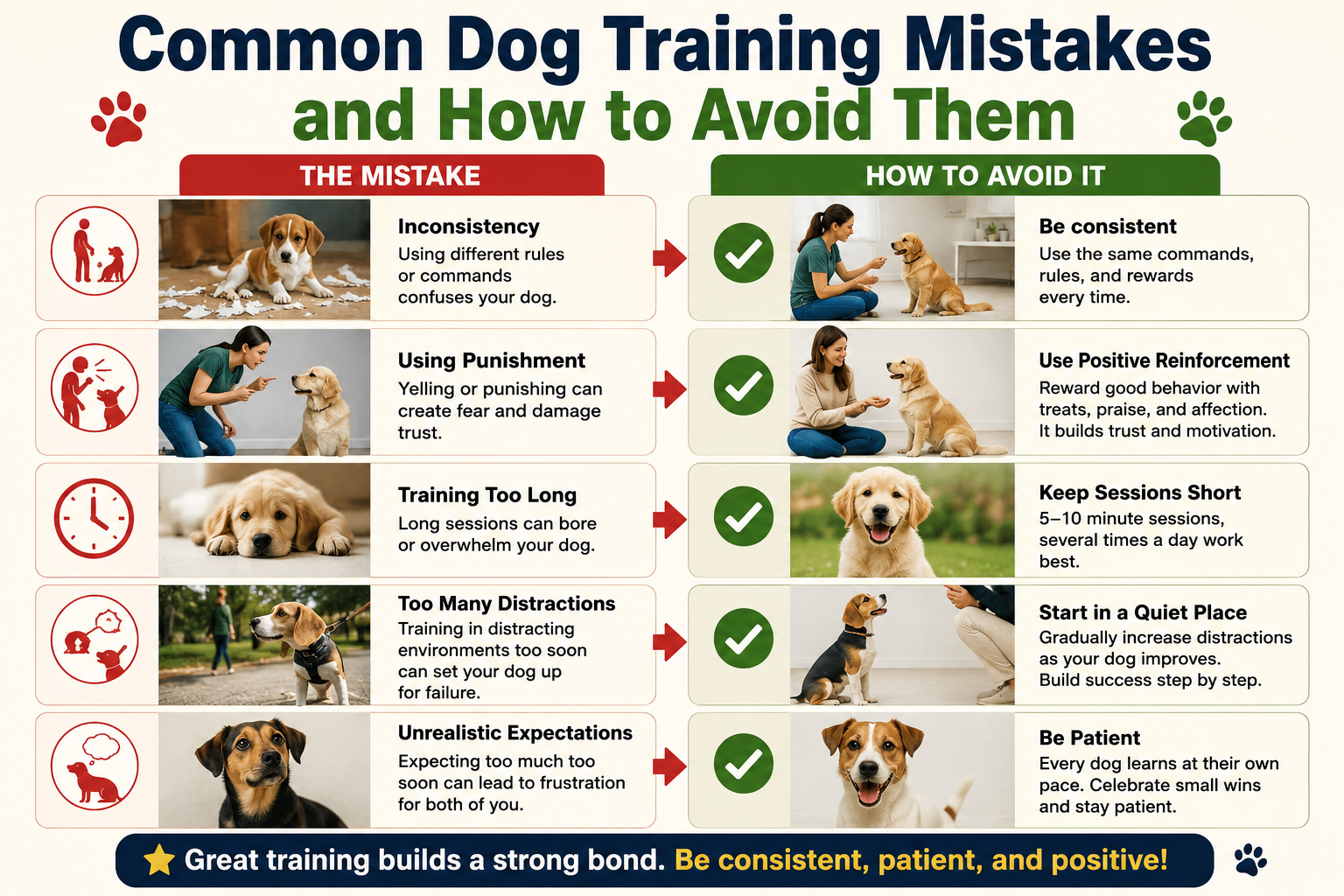
Training your dog should be a rewarding experience, but many owners unknowingly make mistakes that slow down progress. Understanding common dog training mistakes and how to avoid them can help you build a stronger relationship with your pet while teaching good behavior more effectively. Whether you have a playful puppy or an adult dog, avoiding these errors will make training easier, faster, and more enjoyable for both of you.
Why Dog Training Mistakes Matter
Every interaction with your dog is a learning opportunity. Dogs thrive on consistency, patience, and positive reinforcement. When training methods are inconsistent or confusing, dogs may develop unwanted behaviors such as excessive barking, jumping, leash pulling, or ignoring commands.
1. Being Inconsistent with Commands
One of the biggest dog training mistakes is using different words for the same command.
For example, saying “Come,” “Here,” and “Come here” interchangeably can confuse your dog.
How to Avoid It
- Use one command for each behavior.
- Make sure every family member uses the same words.
- Reward your dog every time they respond correctly.
Consistency builds trust and speeds up learning.
2. Expecting Results Too Quickly
Many new dog owners expect their dog to master commands after only a few sessions. In reality, learning takes time and repetition.
How to Avoid It
- Keep training sessions between 5 and 15 minutes.
- Practice daily.
- Celebrate small improvements.
Patience leads to long-term success.
3. Using Punishment Instead of Positive Reinforcement
Yelling, hitting, or using harsh corrections may stop unwanted behavior temporarily, but it often creates fear and anxiety.
Positive reinforcement encourages your dog to repeat good behavior because they associate it with rewards.
Better Alternatives
- Give treats.
- Offer praise.
- Use favorite toys.
- Reward immediately after the correct behavior.
Dogs learn much faster when they enjoy training.
4. Training for Too Long
Long training sessions can overwhelm your dog.
Dogs, especially puppies, have short attention spans.
Ideal Training Schedule
| Dog Age | Session Length |
|---|---|
| Puppies | 5–10 minutes |
| Young Dogs | 10–15 minutes |
| Adult Dogs | 15–20 minutes |
Several short sessions each day are far more effective than one long session.
5. Rewarding Bad Behavior Accidentally
Sometimes owners unknowingly reinforce unwanted behaviors.
Examples include:
- Petting a jumping dog.
- Giving attention when barking.
- Offering treats to stop whining.
Your dog learns that these behaviors get rewarded.
How to Avoid It
Only reward calm, desirable behaviors. Ignore attention-seeking actions whenever possible and reward your dog once they behave appropriately.
6. Skipping Socialization
Proper socialization is essential during puppyhood but remains important throughout a dog’s life.
Safe Socialization Tips
- Visit parks.
- Meet friendly dogs.
- Introduce different sounds.
- Walk in new neighborhoods.
- Invite visitors home.
Positive experiences build confidence.
7. Not Practicing in Different Locations
Many dogs obey perfectly at home but ignore commands outdoors.
This happens because dogs don’t automatically understand that commands apply everywhere.
Solution
Practice commands in different environments:
- Living room
- Backyard
- Local park
- Walking trails
- Pet-friendly stores
Gradually increase distractions as your dog improves.
8. Giving Commands Repeatedly
Repeating “Sit, sit, sit, sit!” teaches your dog they don’t need to respond immediately.
Instead:
- Say the command once.
- Wait a few seconds.
- Guide your dog if necessary.
- Reward the correct response.
This encourages faster obedience.
9. Ignoring Mental Exercise
Physical exercise alone isn’t enough.
Dogs also need mental stimulation to stay happy and well-behaved.
Great mental activities include:
- Puzzle toys
- Hide-and-seek games
- Nose work
- Obedience training
- Food-dispensing toys
Mental enrichment helps reduce boredom and destructive behavior.
10. Quitting Too Early
Many owners stop training once basic commands are learned.
However, training should continue throughout your dog’s life.
Regular practice reinforces good habits and prevents unwanted behaviors from returning.
Even experienced dogs benefit from learning new tricks and commands.
Signs Your Dog Training Is Working
Watch for these positive improvements:
- Responds to commands quickly
- Walks calmly on a leash
- Less barking
- Better focus
- Increased confidence
- Improved social behavior
- Stronger bond with family
Progress may be gradual, but consistency always pays off.
Expert Tips for Successful Dog Training
Professional dog trainers recommend following these simple guidelines:
- Keep sessions short and fun.
- End every session on a positive note.
- Reward good behavior immediately.
- Stay patient and calm.
- Practice every day.
- Use high-value treats during difficult training.
- Gradually increase distractions.
- Be consistent with commands and rules.
These habits create lasting results and make training enjoyable for both you and your dog.
Conclusion
Understanding common dog training mistakes and how to avoid them is the first step toward raising a confident, well-behaved dog. By staying consistent, using positive reinforcement, keeping training sessions short, and practicing regularly, you’ll achieve better results while strengthening your bond with your pet. Remember, successful dog training isn’t about perfection—it’s about patience, persistence, and building trust every day.
FAQs:
What is the biggest mistake in dog training?
The biggest mistake is inconsistency. Using different commands or allowing behaviors sometimes but not others confuses dogs and slows learning.
Is positive reinforcement better than punishment?
Yes. Positive reinforcement is widely recommended because it builds trust, improves learning, and reduces fear-based behaviors.
How long should dog training sessions be?
Most sessions should last between 5 and 15 minutes, depending on your dog’s age and attention span.
Why doesn’t my dog listen outside?
Outdoor environments have more distractions. Practice commands in different locations while gradually increasing difficulty.
Can older dogs still be trained?
Absolutely. Adult and senior dogs can learn new commands with patience, consistency, and positive reinforcement.